
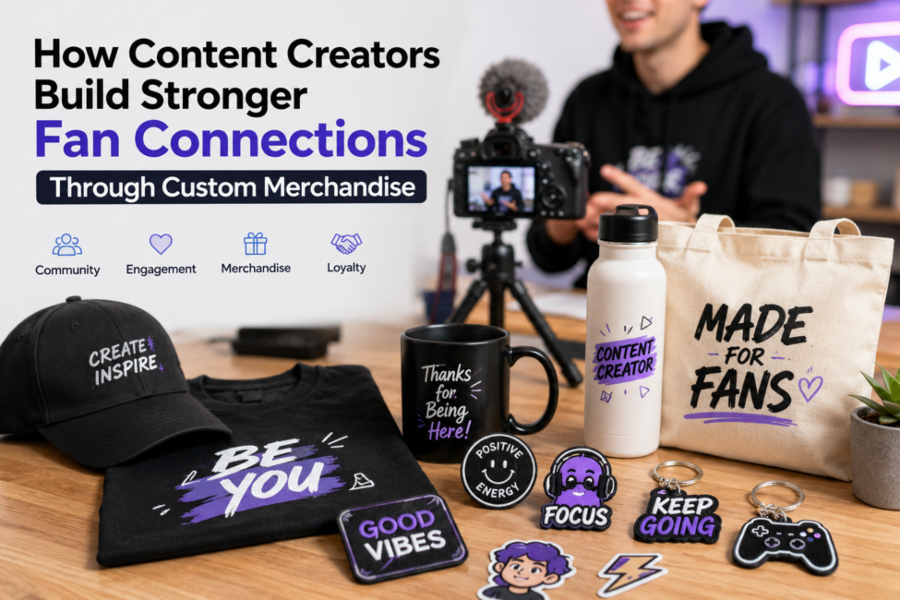
In today’s creator economy, getting an audience isn’t really the hard part anymore.
On TikTok, YouTube, Instagram… content can move fast. Sometimes it moves a bit too fast. A video that was just uploaded can suddenly take off, pulling in thousands, sometimes far more, before anyone really has time to predict it.
But that’s also where things get unstable.
Because attention doesn’t hold for long. It appears, then disappears into the next wave of content. What was visible a day ago might already be buried.
So the focus shifts without much announcement.
It stops being just about visibility. It becomes something closer to memory—whether people still think about it after they scroll away.
That’s one reason creators slowly start looking beyond digital space. Not abandoning content, just adding something that doesn’t vanish with the feed.
Custom merchandise sits in that space. Not always as “strategy,” sometimes just as a natural extension of identity.
Why Physical Merchandise Matters in a Digital-First Environment
Most creator–fan interaction happens in digital environments.
Comments, livestream chats, likes—quick exchanges that feel active in the moment but don’t really stay.
Once the video is gone from circulation, so is most of that attention.
Physical merchandise doesn’t behave like that.
It doesn’t depend on timing or algorithms. Once it exists in someone’s space, it just stays there. On a desk. In a pocket. Hanging from a bag.
No interaction required.
And over time, that’s exactly what changes things.
The presence becomes passive but continuous. It doesn’t ask for attention—it simply keeps showing up in daily routines.
Common Merchandise Formats and Their Functional Roles
Different formats don’t really serve the same purpose, even if they look similar at first glance.
Some are more expressive, some more practical. A few sit somewhere in between.
Stickers
Stickers are usually the starting point.
They’re simple, low-cost, and easy to move around—no real friction in production or usage.
But what’s interesting is how casually people treat them. They get stuck on laptops, bottles, notebooks, sometimes peeling off and moving elsewhere. They don’t feel “precious,” which is exactly why they spread easily.
And once they’re placed somewhere, they quietly turn into small signals. Nothing loud. Just enough to say “this belongs to something.”
Custom PVC Patches
PVC patches feel more grounded.
They have weight visually, even if they’re small. The material gives them a raised, almost dimensional look that printed items don’t really have.
Creators don’t usually use them for random visuals. They tend to sit on core elements—icons, mascots, symbols that keep appearing across different content.
So instead of blending in, they often sit right at the center of a collection, almost like an anchor point that everything else references.
Custom Pins
Pins may be small, but they are often tied to details that matter within a community.
Some pin designs are based on moments that have become familiar within a creator’s community. To someone discovering the channel for the first time, the artwork may not seem unusual. For long-time followers, however, the design often recalls a specific livestream, running joke, or character they already know.
So they function less like decoration, more like recognition.
Custom Keychains
Keychains are more practical than most other formats.
They attach to everyday objects—keys, bags, travel gear—and stay there without needing attention.
People don’t really “use” them in a deliberate way. They just exist in routines.
And that repetition is where familiarity builds, not through interaction, but through exposure over time.
Custom Lanyards
Lanyards show up in more public or shared environments.
Offices, schools, events—places where identification is required.
So they move differently from personal items. They don’t stay hidden in private spaces. They pass through group settings.
That makes their visibility less personal, but more socially distributed. People see them without necessarily focusing on them.
T-shirts and Hoodies
Apparel is probably the most direct form of visible identity.
Once worn, it stops being just a product. It becomes part of how someone appears in public.
Not always intentional, but still readable.
A T-shirt or hoodie can quietly signal affiliation without needing explanation.
Hoodies are generally treated as premium items, largely because they use more material and tend to sell during cooler seasons. T-shirts, by comparison, appear more often in merchandise collections and fit a wider range of everyday situations.
Both end up doing the same thing in different ways—making identity visible outside digital space.
Integrating Merchandise Into Content Strategy
Merch doesn’t always appear as a finished “launch.”
In many cases, it shows up slowly.
A rough sketch in a video. A passing idea mentioned during a livestream. Sometimes even a half-developed concept is still open to change.
At that point, it’s not really a product yet. It’s more like something the audience is watching unfold in real time.
Other times, merchandise gets tied to specific moments—milestones, story arcs, community events. When that happens, it doesn’t feel like a separate release.
It feels like it belongs to the content itself.
By the time it finally goes live, people usually aren’t seeing it for the first time. They’ve already been around it in some form.
That’s where attachment starts building.
Not at purchase. Earlier.
Production Reality and Time-Sensitive Demand Scenarios
Even with a clear idea, timing is often what decides whether it works or not.
In creator-driven environments, merchandise rarely follows a long production cycle. It’s usually triggered by events like:
- hitting follower milestones
- birthday or anniversary streams
- sudden viral spikes
- short community campaigns
- live events or meetups
These moments don’t pause.
If production is slow, the moment passes before the product arrives.
That’s why flexibility matters more than it might seem at first.
Some suppliers are set up to begin production quickly once artwork is confirmed. GSJJ is sometimes used for simpler product types like keychains or patches, where production can start shortly after final approval. Of course, actual timelines still depend on material choices, order size, and finishing requirements.
In practice, creators rarely plan merch in isolation. It usually reacts to timing rather than sitting in a fixed schedule.
How Merchandise Contributes to Community Identity
The most effective merchandise isn’t necessarily the most complex one.
What matters more is whether it connects back to something shared.
A recurring joke. A visual detail from a specific video. A symbol that marks a moment in the community’s timeline.
These things don’t need explanation inside the group. People already know.
And over time, these items stop feeling like products.
They become small markers of participation—proof of having been there when something happened.
Understanding the Limits of Merchandise
Merch doesn’t automatically work just because it exists.
Audience size alone doesn’t guarantee engagement.
Sometimes smaller communities respond more strongly than large ones, simply because the emotional connection is deeper and more stable.
Design also plays a quiet but important role.
If something feels disconnected from the creator’s content, interest tends to drop quickly—even if the product itself is well made.
So in most cases, merchandise only works when it grows out of the community, not when it’s imposed on it.
Conclusion
Custom merchandise has gradually moved into a different role within the creator economy.
It isn’t just an add-on anymore. In many cases, it acts as a physical extension of digital interaction.
Small objects, wearable items, limited drops—they all shift online engagement into something that can exist outside the screen.
Not immediately, and not always in a visible way.
But over time, they start showing up in daily environments, quietly.
And once that happens, the connection doesn’t rely on active viewing anymore.
It just stays there.
FAQ
Why do some creators prefer small collectible items over apparel?
Small items are easier to test. Since there are no size options to manage, production and inventory tend to be simpler. This allows creators to try new designs or release smaller quantities before deciding whether to expand a collection.
Why do creators release merchandise in small batches instead of large production runs?
Small batches reduce uncertainty. They allow creators to observe demand first, then adjust later. It also helps avoid overproduction when trends shift quickly.
Which custom keychains offer the fastest turnaround for rush orders, and how do prices compare?
A fast turnaround doesn’t always depend on who makes the keychains. In many cases, the material itself determines how quickly production can move forward, since every manufacturing process is a little different.
Acrylic keychains are typically the quickest. The process is fairly simple, mostly printing and cutting, so there are fewer steps involved. That’s why they are often used when timing is tight.
PVC keychains can also move through production fairly quickly, especially for simpler designs. However, since they still require a molding stage, they usually take a bit more time compared to acrylic.
Metal keychains usually take the most time to make. Unlike softer materials, they can’t be finished in just a few straightforward steps. The work moves from mold making to casting, then on to polishing, plating, and final finishing, with each stage completed before the next one starts.
Under normal production conditions, the differences usually fall into these ranges:
- Acrylic keychains: around 2–4 days, usually about $0.5–$2 per unit depending on size, detail, and quantity
- PVC keychains: around 3–6 days, typically about $1–$3 per unit depending on color count and design complexity
- Metal keychains: around 5–10 days, usually about $2–$6+ per unit depending on material, plating, and finishing process
In practice, acrylic is often chosen when speed and budget matter most. PVC tends to sit in the middle, balancing timing and durability. Metal is slower and more expensive, but it is usually selected when the final look and perceived quality are more important.
How do creators handle design updates after launching a product?
Instead of replacing older designs, many creators expand them. New variations or updated versions are released over time, often shaped by feedback and content direction.
How does a consistent visual style affect creator merchandise?
Supporters often recognize familiar design elements without paying much attention to them. Reusing certain colors, icons, characters, or graphic styles across different releases helps create a visual connection between products, even when the items themselves are different.