
Marketing automation long ran as an army of if-then rules. We had triggers, waits, and manual tweaks.
But B2B teams now spend too many hours on segmentation, copy iterations, and score maintenance while buyers expect one-to-one relevance.
How do operations teams escape the treadmill and scale genuine personalization without hiring endlessly? Through Agentic AI.
They are autonomous systems that perceive, reason, and act inside Marketo. They will turn deployment into decisioning and lift mundane work out of human queues.
Let’s cut to the chase and learn how AI agents can transform Marketo email marketing strategies in 2026.
Table of Contents
|
From automation to agentic AI: what’s changing in Marketo?
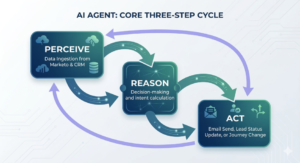
An AI agent is an autonomous (or semi-autonomous) software actor that ingests signals, reasons about intent, and executes actions with optional human oversight.
Marketo’s roadmap shifts away from brittle triggers toward embedded agents that suggest next steps, auto-adjust journeys, and dynamically update scores.
“AI agents are autonomous (or semi-autonomous) software systems designed to perceive data, make decisions, and take actions without requiring constant human input.”
– Ruth Juni, Director of Product Marketing, Demandbase
Marketo will map behavioral signals, predictive attributes, and CRM state into a continuous feedback loop that learns which messages move the pipeline.
4 ways AI agents are redefining Marketo email marketing
Here are four strategies AI agents use to redefine Marketo email marketing.
1. Hyper-personalization at scale, the end of traditional segmentation
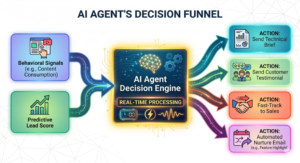
AI agents replace bucketed lists with per-recipient intent profiles. They fuse product activity, content consumption, and buying signals to decide the single best email for each person at send time.
Marketo Predictive Audiences will power these decisions, reducing list fatigue and improving relevance.
2. Autonomous content generation & A/B/C testing
Generating subject lines and variants becomes a throughput problem that agents solve automatically. Agents spin candidate subject lines and body permutations, deploy controlled A/B/C tests, and promote winners into production.
The Marketo Email Designer AI Assistant will synthesize brand-safe copy and imagery in line, shortening creative cycles.
3. Dynamic journey orchestration
Journeys stop being linear schedules and become adaptive maps. Agents re-route users in real time, swapping a testimonial for a technical brief when intent signals change, keeping paths short and decisive.
This reduces waste and accelerates conversion windows.
4. Smart lead routing and predictive scoring
Agents combine explicit CRM fields with implicit engagement to rank real intent. Rather than static point systems, probability models surface only those leads with true conversion likelihood.
Sales receive clearer signals, not noise.
Now, if you want to build an AI-powered lifecycle engine in Marketo, here is a step-by-step guide to do it effectively.
How to build an AI-powered lifecycle engine in Marketo (step-by-step)
Step 1: Define ICP and outcomes.
Agent recommendations are only as good as the objective you give them; lock down ICP attributes, success metrics, and escalation rules first.
Step 2: Stream signals and connect external agents via webhooks.
Use Marketo webhooks and REST endpoints to push events to a scoring service or an external agent, then ingest predictions back as custom attributes.
Step 3: Start human-in-the-loop.
Begin with agents that propose actions (suggested subject, send time, routing); gate record edits behind approvals until trust metrics hit thresholds.
Step 4: Deploy controlled automation.
Run agentic controls on a subset (10–20%) and use randomized holdouts to validate incrementality before wider roll-out.
Now comes the crucial part: What are the crucial metrics?
The ROI of agentic email marketing: Measure what matters
Legacy measures (opens) lie. Finance cares about pipeline velocity and conversion lift.
Build live dashboards that tie engagement to closed revenue and monitor both short-window conversion and downstream expansion.
4-Layer B2B attribution model
| Layer | Signal examples | Business metric |
| Discovery | Ad click, landing page visit | Lead creation rate |
| Engagement | Email click, content downloads | MQL conversion |
| Acceleration | Demo booked, pricing page views | Opportunity creation |
| Expansion | Renewal intent, upsell activity | Expansion revenue |
Use Marketo data + CRM closed-won revenue to populate each layer and report lift: conversion within X days after agent treatment versus holdouts.
Operational guardrails: Governance, safety, and performance
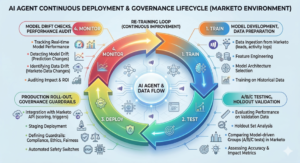
Agents amplify both wins and mistakes; governance is non-negotiable. Set tone boundaries, mandatory review windows for high-impact edits, and rate caps for auto-send decisions.
Log every decision, store model versions, and maintain rollback playbooks for aberrant behavior.
Practical architecture: Events, models, and runbooks
Keep signals deterministic: canonical event names, normalized timestamps, and deterministic IDs.
Host models where you can retrain and version them (in a warehouse or dedicated ML infrastructure) and push predictions back into Marketo as attributes.
Operational runbook essentials: model drift checks, decision-audit reports, and a “stop-the-presses” escalation path.
Quick pilot blueprint (8–12 weeks)
- Week 1–2: Signal audit and ICP validation.
- Week 3–4: Implement webhook pipeline and simple rule-based agent (subject line recommendation).
- Week 5–8: Run A/B/C experiments with agent suggestions vs. human control.
- Week 9–12: Add routing/predictive score, run holdout tests, and measure conversion lift.
Success markers: reduced manual hours, validated conversion lift, and repeatable runbook for expansion.
Wrapping up
That brings us to the business end of the article, where it’s fair to say that from production to strategy
By 2026, Marketo email marketing will stop being a deployment engine and become a decisioning platform.
Agents will not replace marketers; they will displace the busywork that hides strategic thinking.
The real advantage goes to teams that design constraints, validate incrementality, and govern agent behavior with discipline.